E
EduScale
319 challenges in the catalogue. Browse freely; sign in to open the editor and submit.
You are given an m x n grid where each cell can have one of three values:
0 representing an empty cell,1 representing a fresh orange, or2 representing a rotten orange.Every minute, any fresh orange that is 4-directionally adjacent to a rotten orange becomes rotten.
Return the minimum number of minutes that must elapse until no cell has a fresh orange. If this is impossible, return -1.
Example 1:
Input: grid = [[2,1,1],[1,1,0],[0,1,1]]
Output: 4
Example 2:
Input: grid = [[2,1,1],[0,1,1],[1,0,1]]
Output: -1
Explanation: The orange in the bottom left corner (row 2, column 0) is never rotten, because rotting only happens 4-directionally.
Example 3:
Input: grid = [[0,2]]
Output: 0
Explanation: Since there are already no fresh oranges at minute 0, the answer is just 0.
m == grid.lengthn == grid[i].length1 <= m, n <= 10grid[i][j] is 0, 1, or 2.Given a string s, return the longest palindromic substring in s.
A string is a palindrome when it reads the same backward as forward.
A substring is a contiguous sequence of characters within the string.
Example 1:
Input: s = "babad"
Output: "bab"
Explanation: "aba" is also a valid answer.
Example 2:
Input: s = "cbbd"
Output: "bb"
1 <= s.length <= 1000s consist of only digits and English letters.Given the head of a singly linked list, return true if it is a palindrome or false otherwise.
Example 1:
Input: head = [1,2,2,1]
Output: true
Example 2:
Input: head = [1,2]
Output: false
[1, 10^5].0 <= Node.val <= 9Could you do it in O(n) time and O(1) space?
There are a total of numCourses courses you have to take, labeled from 0 to numCourses - 1. You are given an array prerequisites where prerequisites[i] = [ai, bi] indicates that you must take course bi first if you want to take course ai.
[0, 1], indicates that to take course 0 you have to first take course 1.Return true if you can finish all courses. Otherwise, return false.
Example 1:
Input: numCourses = 2, prerequisites = [[1,0]]
Output: true
Explanation: There are 2 courses. To take course 1 you need to take course 0. This is possible.
Example 2:
Input: numCourses = 2, prerequisites = [[1,0],[0,1]]
Output: false
Explanation: There are 2 courses. To take course 1 you need to take course 0, and to take course 0 you also need to take course 1. This creates a cycle, so it is impossible to finish all courses.
1 <= numCourses <= 20000 <= prerequisites.length <= 5000prerequisites[i].length == 20 <= ai, bi < numCoursesprerequisites[i] are unique.Given an array of strings words representing an English Dictionary, return the longest word in words that can be built one character at a time by other words in words.
If there is more than one possible answer, return the longest word with the smallest lexicographical order. If there is no answer, return the empty string.
Note that the word should be built from left to right with each additional character being added to the end of the previous word.
Example 1:
Input: words = ["w","wo","wor","worl","world"]
Output: "world"
Explanation: The word "world" can be built one character at a time by "w", "wo", "wor", and "worl".
Example 2:
Input: words = ["a","banana","app","appl","ap","apply","apple"]
Output: "apple"
Explanation: Both "apply" and "apple" can be built from other words in the dictionary. However, "apple" is lexicographically smaller than "apply".
1 <= words.length <= 10001 <= words[i].length <= 30words[i] consists of lowercase English letters.Given an undirected connected graph with n vertices (numbered 0 to n-1) and a list of edges, where edges[i] = [u, v, weight], find the total weight of the Minimum Spanning Tree (MST).
A Minimum Spanning Tree is a subset of the edges of a connected, edge-weighted undirected graph that connects all the vertices together, without any cycles and with the minimum possible total edge weight.
Input: n = 4, edges = [[0,1,1],[1,2,2],[2,3,3],[0,3,4],[0,2,5]]
Output: 6
Explanation: The MST includes edges (0,1), (1,2), and (2,3) with weights 1+2+3 = 6.
Input: n = 3, edges = [[0,1,5],[1,2,1],[0,2,1]]
Output: 2
Explanation: The MST includes edges (1,2) and (0,2) with weights 1+1 = 2.
1 <= n <= 10^4n-1 <= edges.length <= 10^50 <= edges[i][2] <= 10^6 (weight)Design and implement a URL shortening service similar to bit.ly or TinyURL. The system should generate short, unique aliases for long URLs, resolve short URLs back to originals, handle high read traffic with caching, and provide click analytics.
POST /api/shorten
  Body: { url: string, customAlias?: string, expiresAt?: string }
  Response: { shortUrl: string, shortCode: string, createdAt: string }

GET /:shortCode
  Response: 301 Redirect to original URL

GET /api/analytics/:shortCode
  Response: { totalClicks: number, clicksByDay: [...], topReferrers: [...] }
POST /api/shorten
{ "url": "https://example.com/very/long/article/about/system-design" }

Response (201):
{
  "shortUrl": "https://short.ly/a1B2c3",
  "shortCode": "a1B2c3",
  "originalUrl": "https://example.com/very/long/article/about/system-design",
  "createdAt": "2024-01-15T10:00:00Z"
}
POST /api/shorten
{ "url": "https://example.com/promo", "customAlias": "sale2024" }

Response (201):
{ "shortUrl": "https://short.ly/sale2024", "shortCode": "sale2024" }
You are a professional robber planning to rob houses along a street. Each house has a certain amount of money stashed, the only constraint stopping you from robbing each of them is that adjacent houses have security systems connected and it will automatically contact the police if two adjacent houses were broken into on the same night.
Given an integer array nums representing the amount of money of each house, return the maximum amount of money you can rob tonight without alerting the police.
Example 1:
Input: nums = [1,2,3,1]
Output: 4
Explanation: Rob house 1 (money = 1) and then rob house 3 (money = 3).
Total amount = 1 + 3 = 4.
Example 2:
Input: nums = [2,7,9,3,1]
Output: 12
Explanation: Rob house 1 (money = 2), rob house 3 (money = 9) and rob house 5 (money = 1).
Total amount = 2 + 9 + 1 = 12.
Example 3:
Input: nums = [2,1,1,2]
Output: 4
Explanation: Rob house 1 (money = 2) and house 4 (money = 2).
Total amount = 2 + 2 = 4.
1 <= nums.length <= 1000 <= nums[i] <= 400Given the root of a binary tree, the value of a target node target, and an integer k, return an array of the values of all nodes that have a distance k from the target node.
You can return the answer in any order.
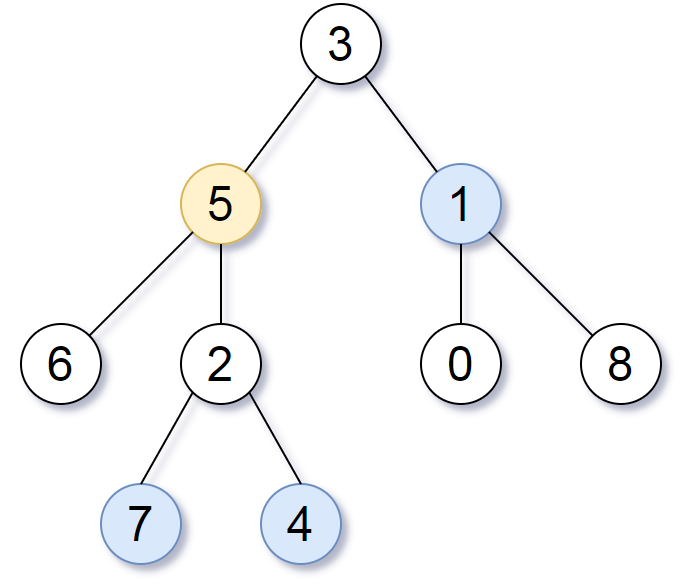 Input:
 root = [3,5,1,6,2,0,8,null,null,7,4], target = 5, k = 2
Output: [7,4,1]
Explanation: The nodes that are a distance 2 from the target node (with value 5) have values 7, 4, and 1.
Input: root = [1], target = 1, k = 3
Output: []
[1, 500].0 <= Node.val <= 500Node.val are unique.target is the value of one of the nodes in the tree.0 <= k <= 1000We are given an array asteroids of integers representing asteroids in a row.
For each asteroid, the absolute value represents its size, and the sign represents its direction (positive meaning right, negative meaning left). Each asteroid moves at the same speed.
Find out the state of the asteroids after all collisions. If two asteroids meet, the smaller one will explode. If both are the same size, both will explode. Two asteroids moving in the same direction will never meet.
Input: asteroids = [5,10,-5]
Output: [5,10]
Explanation: The 10 and -5 collide resulting in 10. The 5 and 10 never collide.
Input: asteroids = [8,-8]
Output: []
Explanation: The 8 and -8 collide exploding each other.
Input: asteroids = [10,2,-5]
Output: [10]
Explanation: The 2 and -5 collide resulting in -5. Then 10 and -5 collide resulting in 10.
2 <= asteroids.length <= 10^4-1000 <= asteroids[i] <= 1000asteroids[i] != 0You are given an m x n integer array obstacleGrid. There is a robot initially located at the top-left corner (i.e., obstacleGrid[0][0]). The robot tries to move to the bottom-right corner (i.e., obstacleGrid[m - 1][n - 1]). The robot can only move either down or right at any point in time.
An obstacle and space are marked as 1 and 0 respectively in the grid. A path that the robot takes cannot include any square that is an obstacle.
Return the number of possible unique paths that the robot can take to reach the bottom-right corner.
Example 1:
Input: obstacleGrid = [[0,0,0],[0,1,0],[0,0,0]]
Output: 2
Explanation: There is one obstacle in the middle of the 3x3 grid.
There are two ways to reach the bottom-right corner:
1. Right -> Right -> Down -> Down
2. Down -> Down -> Right -> Right
Example 2:
Input: obstacleGrid = [[0,1],[0,0]]
Output: 1
m == obstacleGrid.lengthn == obstacleGrid[i].length1 <= m, n <= 100obstacleGrid[i][j] is 0 or 1.Given an integer array nums, find the subarray with the largest sum, and return its sum.
A subarray is a contiguous non-empty sequence of elements within an array.
Example 1:
Input: nums = [-2,1,-3,4,-1,2,1,-5,4]
Output: 6
Explanation: The subarray [4,-1,2,1] has the largest sum 6.
Example 2:
Input: nums = [1]
Output: 1
Explanation: The subarray [1] has the largest sum 1.
Example 3:
Input: nums = [5,4,-1,7,8]
Output: 23
Explanation: The subarray [5,4,-1,7,8] has the largest sum 23.
1 <= nums.length <= 10^5-10^4 <= nums[i] <= 10^4If you have figured out the O(n) solution, try coding another solution using the divide and conquer approach, which is more subtle.
GET /a1B2c3
Response: 301 Redirect -> https://example.com/very/long/article/about/system-design